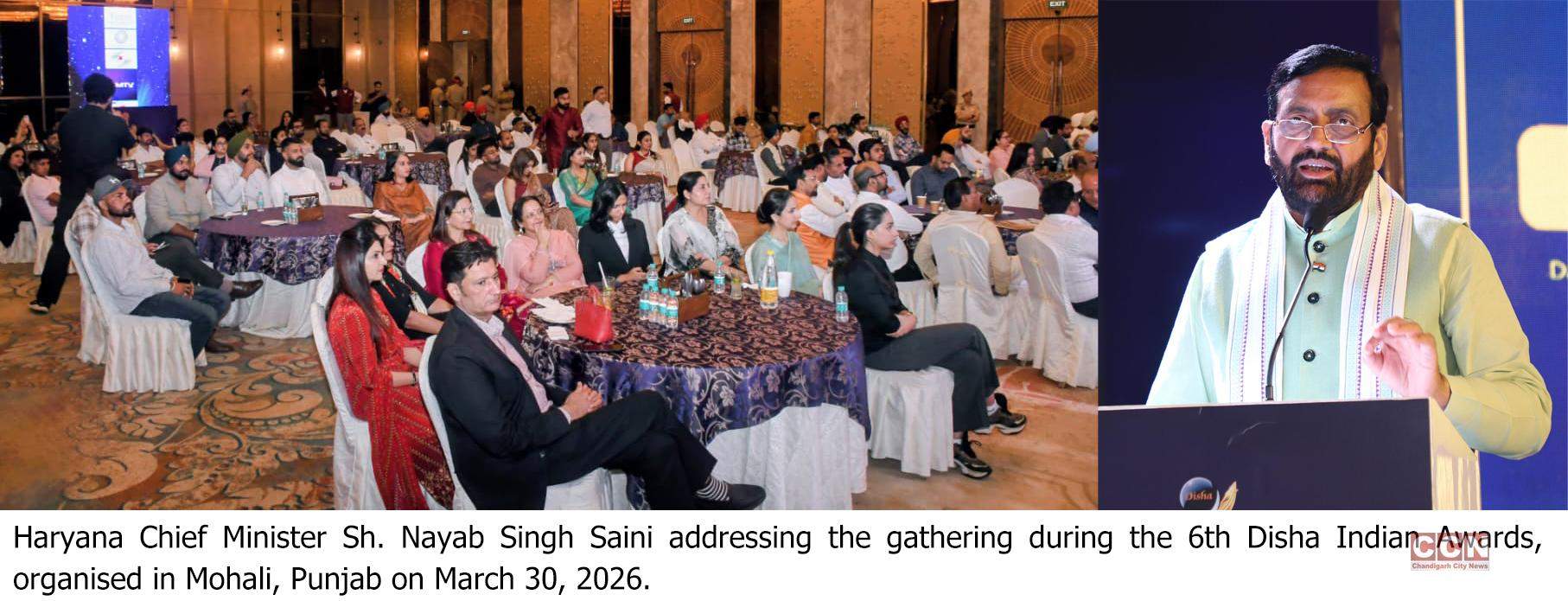
Haryana Chief Minister Nayab Singh Saini honoured citizens who have performed outstanding work in different fields at the sixth Disha Indian Awards held in Mohali, Punjab.
Addressing the event organized by Disha Women Welfare Trust, the Chief Minister said that today’s occasion is a celebration of countless struggles, dreams, and commitments that have contributed to giving a new direction to society. He said that the Disha Indian Awards present a picture of an India that is progressing on the strength of women and is rooted in the values of dedication and service.
The Chief Minister said that organizing the sixth edition of the awards by Disha Women Welfare Trust is highly commendable. He described the institution not just as an organization, but as a movement that has, for the past five years, been continuously working to empower both women and men, promote self-reliance, and ensure recognition of their contributions to society. He emphasized the need to ensure equal opportunities, safety, and empowerment for women in every field.
He said that 26 individuals have been honoured on this platform who have done commendable work for women’s upliftment. These individuals are the real heroes of society who have worked selflessly with a spirit of service and dedication. Under the able leadership of Prime Minister Sh. Narendra Modi, India is rapidly transforming. This new India is driven by the strength of women. He added that the goal of building a developed India set by the Prime Minister cannot be achieved without their contribution, as women constitute half of the country’s population.
The Chief Minister said that women empowerment is not just a women’s issue but a matter concerning the entire society. It is a shared responsibility of families, society, government, and every citizen. He stressed the need to ensure that girls receive an environment from childhood where they can freely pursue their dreams and are made to believe that they are second to none. When a girl is educated, she shapes not only her own future but also that of her family and society.
He congratulated and extended his best wishes to the organizer, Smt. Hardeep Kaur.
He said that 11 years ago, the Prime Minister launched the “Beti Bachao, Beti Padhao” programme from the historic land of Panipat, leading to positive changes across the country. In Haryana, the sex ratio, which was 871 in 2014, has now improved to 923. He also expressed pride that the Prime Minister launched the “Bima Sakhi Yojana” from Panipat, under which 9,656 women in Haryana are advancing their careers as insurance facilitators.
The Chief Minister said that the Prime Minister understood the hardships faced by women, freed them from smoke caused by traditional cooking methods, liberated them from the indignity of open defecation, and relieved them from the suffering of triple talaq. By enacting a law ensuring 33 percent representation in Parliament, women have been given a rightful role in governance.
He said that politics is not merely about promises but a reflection of trust and accountability. Under the Lado Lakshmi Scheme, women are being provided ₹2,100 per month. So far, ₹835 crore has been transferred directly to their accounts in five installments. Just as Disha Women Welfare Trust is dedicated to women’s upliftment, the Haryana Government has also taken concrete steps towards women’s economic empowerment.
He further stated that in the Budget 2026–27, a provision has been made to reserve 20 percent of Vita booth allotments for women belonging to Self-Help Groups. Additionally, there is a provision to establish a modern rural market in every block to facilitate the marketing of SHG products. Earlier, 33 percent of ration depots were allotted to women.
Haryana is the first state in the country to implement a comprehensive crèche policy for the children of working women. At present, 845 crèches are operational in the state, along with 4,000 play-way schools. The budget also provides for launching 10 modern “Matri Shakti Industrial Crèche Networks” in industrial areas. The honorarium of crèche workers has been increased from ₹3,000 to ₹15,000 per month, the highest in the country.
In the financial year 2026–27, an additional 3 lakh women will be made financially self-reliant earners (“Lakhpati Didis”). He noted that it was once unimaginable that women managing households would also fly drones. Under the “Namo Drone Didi” scheme, 5,000 women from 500 Self-Help Groups are being given free training. Women have also been given 50 percent representation in Panchayati Raj Institutions.
He said that on February 28, the Prime Minister launched a nationwide campaign to provide free HPV vaccination to adolescent girls for the prevention of cervical cancer, and the same campaign was launched in Haryana on the same day. In the financial year 2026–27, 3 lakh girls will be vaccinated. Free education for girls is being provided up to the postgraduate level.
He said that when daughters are safe, educated, and empowered, only then will the nation truly progress. The Chief Minister was honored with a shawl and a memento during the event.
On this occasion, former Minister Aseem Goel, Media Secretary to the Chief Minister Praveen Attrey, former Member of Parliament Avinash Rai Khanna, Founder of Kangaroo Group of Companies Rishipal Singh, Chairperson of Disha Trust Smt. Hardeep Kaur, Chairman of Chardikala Time TV Sardar Jagjit Singh Dardi, along with the team of Disha Women Welfare Trust, were present.
HRIDC Projects Gain Momentum with Major Milestones Across Haryana Rail Network
The Haryana Chief Secretary, Sh. Anurag Rastogi, who is also the Chairman of Haryana Rail Infrastructure Development Corporation (HRIDC), presided over the 34th meeting of the Board of Directors, where significant progress across key rail infrastructure projects was reviewed, signalling a transformative phase in the State’s rail connectivity.
Revised Cost Estimate Strengthens Project Vision
It was informed in the meeting that the Cabinet has approved a revised project cost of approximately Rs. 11,709 crore, compared to the earlier sanctioned cost of Rs. 5,618 crore. The Haryana Orbital Rail Corridor (HORC) will provide seamless rail connectivity to major industrial and logistics hubs such as Kharkhoda, Manesar, and Sohna, while also catalysing the development of new townships in the Haryana NCR region. The corridor is expected to play a pivotal role in facilitating faster freight movement, reducing transit time, and accelerating industrial growth.
HORC Tunnel: Major Engineering Milestone Achieved
In a notable engineering accomplishment, excavation of 4,349 metres—around 61% of the total 7,070-metre tunnel—has been completed using the New Austrian Tunnelling Method (NATM). Work is progressing simultaneously from nine faces, reflecting efficient planning and execution. The tunnel remains a critical component of the HORC project and its rapid progress underscores HRIDC’s commitment to timely delivery.
All Key Environmental and Forest Clearances Secured
The project has successfully secured all major environmental and forest clearances, marking the removal of critical regulatory hurdles. Stage-I Forest Clearance was granted in October 2025, followed by approval for the remaining tunnel alignment in village Rojka Meo on March 4, 2026. Additionally, the crucial Aravalli clearance was granted on March 20, 2026, further enabling unhindered construction activity.
Rs.1,929 Crore Compensation Disbursed to Stakeholders
Demonstrating a strong commitment to stakeholder welfare, HRIDC has disbursed Rs. 1,929 crore—approximately 85% of the total compensation award of Rs. 2,273 crore—to landowners across five districts. Gurugram has achieved 99% disbursement, followed by Nuh at 94%. Notably, private land compensation has reached Rs. 1,346 crore, accounting for 95% of the total private land award, reflecting a transparent and efficient compensation framework.
Kurukshetra Elevated Track Ready for Commissioning
The Kurukshetra Elevated Track (KET) project is nearing completion and is set for commissioning in April 2026. All 21 spans of the elevated viaduct have been completed, along with civil, track, signalling, and overhead electrification works. The project will soon be presented for inspection by the Commissioner of Railway Safety. The new Thanesar station is also in its final stages and is expected to be completed by April 10, 2026.
Eastern Orbital Rail Corridor
The Eastern Orbital Rail Corridor (EORC), an important inter-state connectivity initiative from Sonipat to Palwal via Baghpat, Ghaziabad, and Gautam Buddha Nagar, is progressing steadily. Field surveys, drone mapping, and traffic assessments have been completed. The revised draft feasibility report was submitted on March 23, 2026, with the final report, including financial analysis, expected shortly.
Towards a New Era of Rail Connectivity
With rapid progress in tunnelling, full regulatory clearances in place, substantial land compensation achieved, and the Kurukshetra Elevated Track on the verge of inauguration, HRIDC’s projects are set to redefine rail mobility across Haryana and the National Capital Region. These initiatives will significantly enhance logistics efficiency, strengthen industrial growth, and position Haryana as a key infrastructure hub in the country.
The meeting was attended by Additional Chief Secretary, PW (B&R) and Architecture Department, A.K.Singh, Special Secretary, Monitoring & Coordination, Dr. Priyanka Soni, Commissioner & Secretary I, Finance Department, Mohammed Shayin and Managing Director, HRIDC, Sukhwinder Singh.
Identify locations for Water Harvesting Systems in Haryana, Implement the same across all Government Departments- CM
Cameras to be installed for Monitoring Sweeping Machines; Uniform Dress Code for SafaiKarmcharis in Haryana- CM
Chief Minister chairs review meeting with Civic Body officers
Haryana Chief Minister, Nayab Singh Saini while chairing a key meeting with the officers of the Urban Local Bodies Department here today directed them to identify suitable locations for installing water harvesting systems across the state. He said that waterlogging issues arise at several places during the rainy season, and therefore, concrete arrangements should be made in advance to address the problem.
During the meeting, he reviewed in detail the pre-monsoon preparations, including drain cleaning, water drainage systems, and sanitation arrangements, and issued necessary directions to the concerned officers. He directed that areas facing drainage issues should be identified and alternative solutions should be adopted. He particularly emphasized exploring the option of installing water harvesting systems at such locations to enable rainwater conservation and significantly reduce waterlogging problems.
The Chief Minister further directed the officers to prepare comprehensive and updated data related to water harvesting in the state. This should include details of locations where such systems are already installed, how many are functioning properly, and where new installations are required. He said that these systems should be effectively implemented across all government departments, and where these systems have not yet been installed, it should be set up on a priority basis, especially in waterlogging-prone areas.
The Chief Minister also held detailed discussions on further improving the sanitation system in the state. The officers apprised the Chief Minister that modern technology, particularly implementing a radio frequency identification (RFID)-based system for door-to-door garbage collection, is being used to strengthen sanitation management, leading to improved monitoring and transparency. Continuous efforts are being made in this direction.
Cameras to be installed for Monitoring Sweeping Machines
The Chief Minister also reviewed the GPS-based waste collection system and directed officials to ensure its effective monitoring. The officers informed that RFID technology is being used in this system to make the waste collection process more organized and transparent.
Providing details of steps taken to strengthen monitoring of sweeping machines, officials stated that four cameras will be installed on each machine—one facing forward, one on top, one below, and one at the rear. It was further stated that if the sensor installed underneath the machine is found to be non-functional during cleaning operations, payment to the concerned agency will not be made.
Additionally, agencies will now be required to submit video footage of their work along with their monthly bills for verification, if required. A penalty provision of ₹1,250 per hour has also been introduced to ensure accountability of agencies and prevent negligence in work.
Focus on Welfare of Safai Karmcharis
The Chief Minister also emphasized the welfare of Safai Karmcharis and directed that they be provided with uniforms, shoes, and other essential safety equipment. He said that special attention should be given to the safety and convenience of Safai Karmcharis so that they can perform their duties effectively. Notably, he has directed the implementation of a uniform dress code for Safai Karmcharis across Haryana.
The meeting also discussed sanitation, drainage, and water availability in major cities like Gurugram and Faridabad. The Chief Minister directed that special attention be given to these urban areas to ensure that the public does not face any inconvenience.
Chief Secretary, Sh. Anurag Rastogi, Principal Secretary to Chief Minister, Sh. Arun Gupta, Additional Principal Secretary to Chief Minister, Dr. Saket Kumar, Commissioner and Secretary, Urban Local Bodies Department, Sh. Ashok Kumar Meena, Director, Sh. Mukul Kumar, along with other departmental officers also attended the meeting.
Ajay Kumar Assigned Additional Charge as Deputy Commissioner of Nuh
The Haryana Government has assigned the additional charge of Deputy Commissioner of Nuh and Chief Executive Officer of the Mewat Development Agency, Nuh, to Ajay Kumar, currently serving as Deputy Commissioner of Gurugram and Chief Administrator of the Shri Mata Sheetla Devi Shrine Board.
Hisar IMC Project Advances Rapidly; Haryana Moves Towards a World-Class Manufacturing Hub
The Haryana Chief Secretary, Sh. Anurag Rastogi, reviewed the progress of the Integrated Manufacturing Cluster (IMC) at Hisar, highlighting substantial achievements and the steady advancement of this flagship project aimed at transforming the region into a premier industrial hub in North India.
Strategic Vision and Location Advantage
The project, spread over approximately 2,988 acres (including 1,605 acres in Phase I), is strategically located with connectivity to NH-52 and NH-09 and is in close proximity to the upcoming Hisar Aviation Hub. As per the project vision, the IMC is being developed under the Amritsar-Kolkata Industrial Corridor (AKIC), positioning Hisar as a key node in the national industrial network.
Balanced Industrial Ecosystem Planned
The proposed master plan reflects a well-balanced industrial ecosystem, with around 61% of the land allocated for industrial and logistics activities, supported by green spaces, utilities, and infrastructure. Key sectors identified include aerospace and defence, engineering and fabrication, food processing, garments, and logistics, ensuring diversified and sustainable industrial growth.
Major Milestones Achieved in Project Preparedness
The IMC Hisar project has made notable progress, with 100% land already in possession and key approvals, including clearance from the National Planning Group (NPG), secured. Environmental Clearance for one part of phase 1 has been obtained and the clearance for rest part of the phase 1 is underway. Critical infrastructure works such as construction of the raw water reservoir, canal realignment, and power supply planning are being actively pursued. One high-tension line has already been dismantled, and further works are underway to ensure uninterrupted infrastructure development.
Positive Outlook for Industrial Growth
The Chief Secretary directed the concerned departments to complete the works within prescribed timelines. He emphasized that the IMC Hisar project represents a major step towards strengthening Haryana’s industrial ecosystem. With strong institutional support, strategic planning, and steady execution, the project is poised to attract investment, generate employment, and drive long-term economic growth.
The IMC Hisar is set to emerge as a model industrial township, reinforcing Haryana’s position as a leading destination for manufacturing and infrastructure development in India.
Dr. G. Anupama, Additional Chief Secretary, Civil Aviation; Sh. Pankaj Agarwal, Principal Secretary, Irrigation and Water Resources; Dr. Amit Kumar Agrawal, Commissioner and Secretary, Industries and Commerce; Dr. Aditya Dahiya, Managing Director, HVPNL; Sh. Sushil Sarwan, Managing Director, HSIIDC; along with other senior officers, were present at the meeting.
CM chairs key meeting with Health Department, Directs Real-Time Centralised Tracking of Medicines in Government Hospitals
Strict action if doctors prescribe outside medicines; CMOs to be held accountable, CM
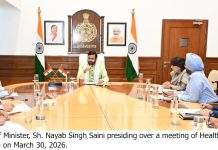
Haryana Chief Minister, Nayab Singh Saini has directed that all government hospitals must maintain medicine records on a real-time centralised portal. Doctors will be able to check the availability of medicines in their respective hospitals, leaving no scope for prescribing medicines from outside. He made it clear that if any doctor still prescribes outside medicines, they must explicitly state on the OPD slip that the medicine is unavailable in the hospital. Responsibility for ensuring compliance will lie with the Chief Medical Officers (CMOs).
The Chief Minister gave these directions while chairing a high-level review meeting on the state’s healthcare services at the Secretariat on Monday. Additional Chief Secretary, Health and Family Welfare Department, Dr. Sumita Misra and Principal Secretary to Chief Minister, Arun Gupta were present.
During the meeting, the Chief Minister reviewed key aspects including availability of medicines, status of medical equipment, OPD management, staffing of doctors and paramedics, procurement systems, and quality of patient care. He said that officers concerned should ensure that patients visiting government hospitals should not face any inconvenience and further directed to maintain continuous monitoring of all services. He categorically said that shortage of medicines at any level will not be tolerated. A robust real-time monitoring system for medicine stocks must be implemented to ensure timely replenishment. He also directed that annual empanelment of suppliers be undertaken and CMOs should communicate medicine requirements to empanelled agencies at least four days in advance to avoid shortages.
The Chief Minister further directed strict action to curb the practice of unnecessarily prescribing outside medicines, ensuring that patients are not burdened with additional expenses and receive treatment within government facilities.
Focus on Strengthening Healthcare Infrastructure
Emphasising the need to upgrade healthcare infrastructure across all districts, the Chief Minister directed that advanced diagnostic facilities such as CT scan and MRI be ensured in all hospitals. Officers apprised the Chief Minister that such upgrades have been completed in 10 districts. The further directed that the remaining 12 districts be covered at the earliest so that patients do not have to travel outside their districts for advanced diagnostics. He also called for phased expansion of healthcare infrastructure to meet future needs.
Adequate Staffing and Timely Treatment
The Chief Minister directed that hospitals be strengthened in line with patient load and adequate availability of doctors, nursing staff, and other healthcare personnel be ensured. He said timely treatment for all patients and called for improvements in staff deployment, duty rosters, and overall functioning. Officers apprised the Chief Minister that until full-time specialists are appointed in medical colleges, doctors will be engaged on a contractual basis.
Accountability and Performance Monitoring
Highlighting the key role of CMOs, the Chief Minister directed that their accountability be clearly defined. He also called for strict adherence to district-wise targets and strengthening of performance-based monitoring systems.
Transparent and Time-Bound Procurement
The Chief Minister directed that procurement of medicines and equipment be made more transparent, efficient, and time-bound. He stressed that there should be no delays in procurement and all processes must adhere to prescribed timelines, while maintaining strict quality standards.
Improved Cleanliness and Patient Services
The Chief Minister also emphasised improving sanitation and overall patient experience in hospitals. He directed that hospitals maintain cleanliness, proper management systems, and a patient-friendly approach. Strengthening of feedback mechanisms was also stressed to enable continuous improvement in services.
In the meeting progress of medical colleges, e-Upchar services, Ayushman scheme, and preparedness in terms of medicine stock, ambulance fuel, and LPG availability for patient meals was also reviewed in view of the current situation. Officers apprised the Chief Minister that adequate arrangements have been made and no shortages exist.
Secretary Health and Mission Director, National Health Mission Haryana, R.S. Dhillon, and Director General Health Services, Dr. Manish Bansal, were also attended the meeting.
Biometric Verification of Selected Group-D Candidates to be Conducted Across Haryana
The Haryana Government has decided to conduct biometric verification of 13,246 candidates selected under Advertisement No. 01/2023 for Common Cadre Group-D posts. The verification process will be carried out across various divisions of the State at the level of Divisional Commissioners, and in Panchkula at the level of the Deputy Commissioner.
According to the schedule, biometric verification of 1,451 candidates will be conducted in Ambala Division on April 20, 2026. Out of these, 1,417 candidates are currently working in various departments, while 34 are attached to the office of the Divisional Commissioner. In Karnal Division, a total of 1,662 candidates will be verified on April 21, , including 1,584 employees from departments and 78 from the Divisional Commissioner’s office.
In Rohtak Division, 3,750 candidates will undergo verification on April 22 and 23, 2026. Among them, 3,389 are working in departments, and 361 are attached to the Divisional Commissioner’s office. In Hisar Division, biometric verification of 2,918 candidates will be conducted on April 24 and 27, , including 2,585 l employees area working in the departments and 333 associated with the Divisional Commissioner’s office.
In Faridabad Division, 960 candidates will be verified on April 28, , of which 954 are working in departments and 6 are attached to the Divisional Commissioner’s office. In Gurugram Division, 1,841 candidates will undergo verification on April 29, including 1,801 employees are working in the departments and 40 from the Divisional Commissioner’s office.
In Panchkula, biometric verification of 664 candidates will be conducted on April 30, 2026. This will include candidates from Chandigarh, Panchkula, and other remaining departments and offices.
All Divisional Commissioners and the Deputy Commissioner, Panchkula have been requested to ensure smooth conduct of the verification process by arranging necessary staff and resources as per the schedule. They have also been directed to submit reports detailing the number of candidates who appeared, remained absent, and were successfully verified.
All Heads of Departments have been directed to ensure that selected Common Cadre Group-D employees report for biometric verification on the scheduled dates. Additionally, departments have been directed to appoint nodal officers at both departmental and divisional levels to ensure proper coordination and timely attendance of candidates.